Compare 3 Executive Succession Planning Templates for SMBs
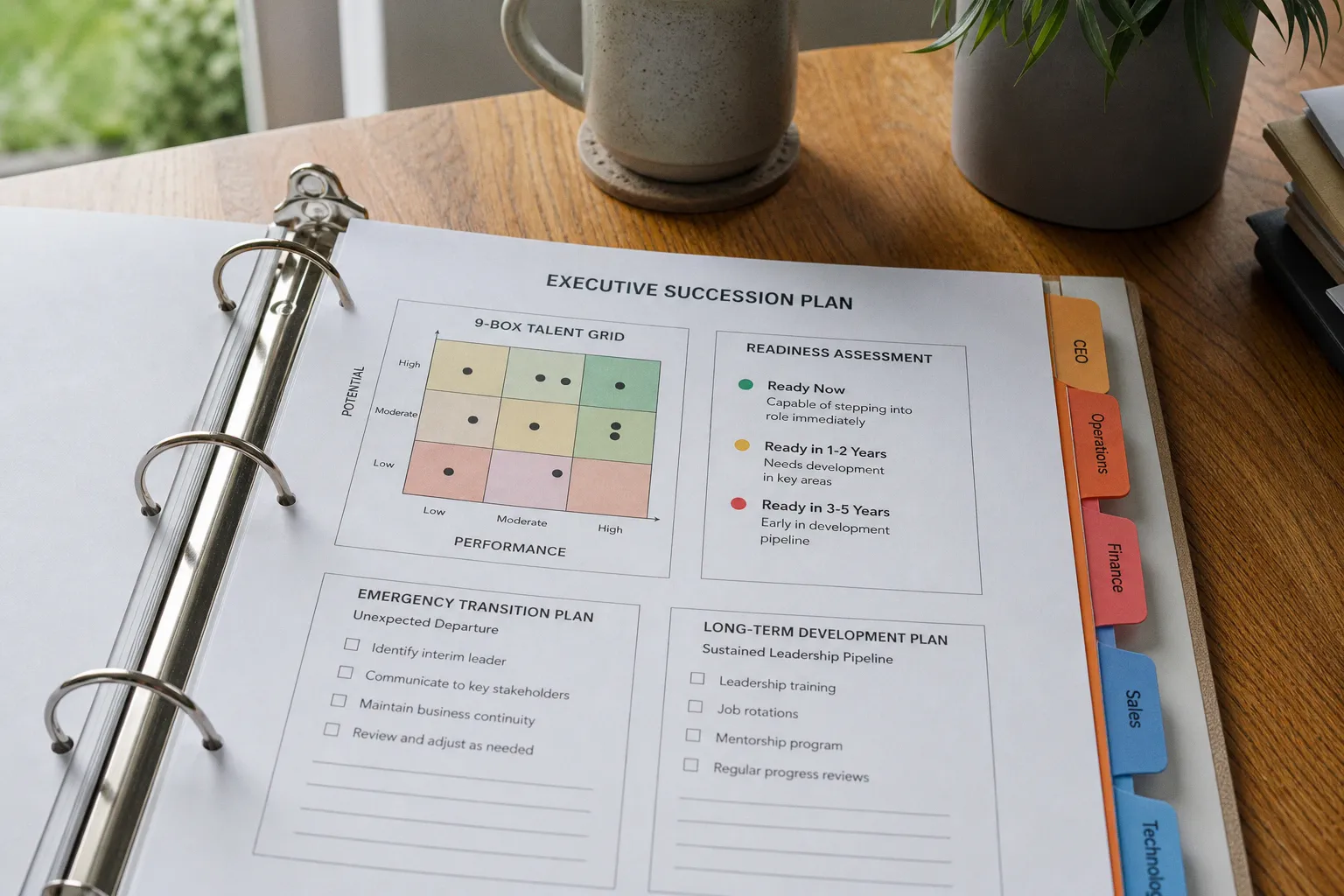
The 9-Box Grid: A Diagnostic, Not a Plan
The 9-Box Grid is the most widely adopted talent assessment instrument in HR practice. Its function is diagnostic. The grid plots every employee on two axes: current performance (X-axis) and future leadership potential (Y-axis). Each axis uses a three-tier rating — low, medium, high — producing nine cells. The output is a binary classification of every leadership-track employee.
A grid without follow-up investment is an org chart with extra steps.
The mechanical value is the removal of ambiguity. A manager who says "Sarah is solid" carries no data. The 9-Box converts that statement to "high performance, medium potential — box 6." Box 6 employees receive different compensation, different development budgets, and different review cadences than box 1 or box 9 employees. The classification drives downstream action with measurable inputs.
The instrument's limitation is structural: it captures a snapshot, not a trajectory. A box 7 employee (high performance, high potential) may be 90 days from ready or nine years from ready. The grid says nothing about runway. Time-horizon data requires a second template.
The 9-Box also has a calibration problem. The "potential" axis is subjective. Two executives reviewing the same employee can place that employee in box 5 or box 7 depending on prior exposure, bias, or departmental loyalty. Without a calibration meeting where the leadership team debates placements against shared criteria, the grid degrades into a private opinion aggregator. The instrument works only when the executive team commits to a quarterly review meeting. That commitment is the cost most SMBs underestimate.
Readiness Horizons: Converting Potential into Calendar Dates
The Readiness Horizon Matrix fixes the time-axis problem the 9-Box cannot. It categorizes every succession candidate into one of three buckets: ready now, ready in 1-2 years, or ready in 3-5 years. The numbers are not arbitrary. They correspond to standard onboarding curves at the SMB scale. A VP-level hire typically requires 12-18 months to reach operational parity. A C-suite hire requires 36-60 months to internalize institutional knowledge, vendor relationships, and customer commitments. The matrix forces these curves to be quantified rather than implied.
A functioning succession program targets a minimum ratio: at least one "ready now" candidate per critical role, with a 1-2 year pipeline filling the next tier. The 3-5 year bucket is developmental capital. It pays off only if the 1-2 year bucket is non-empty. If every candidate sits in the "3-5 years" bucket, the bench does not exist. It is a wish list with budget attached.
The secondary exposure appears at this stage: most SMBs count only the CEO succession candidate and stop. The CFO, the head of operations, the head of revenue — these roles carry equal criticality. A CEO transition with a vacant CFO seat is not a transition. It is a compounded crisis that triggers covenant reviews on outstanding debt. The matrix must be applied across every critical role, not just the top of the org chart.
The matrix also exposes a quantification error common in HR documentation: candidate lists that include names without assessment dates. A candidate "ready in 1-2 years" requires a target quarter, not a label. Without the date, the matrix becomes a sentiment survey. The output should look like an inventory schedule, because that is what it is.
The Critical Role Map: Identifying Single Points of Failure
The Critical Role Map is the third template. Its function is narrow and operational: identify every role whose unplanned vacancy would halt revenue, halt production, or trigger a covenant default on debt. The output is a two-deep backup table — primary backup and secondary backup — for every role that passes the filter.
The benchmark for an SMB operating at scale is 100% of critical roles with a designated backup. Anything below that figure is uninsured exposure. The exercise is mechanical and runs in three steps:
- Step one: enumerate every role in the company. Include the role, not the person. Roles persist; people leave.
- Step two: apply the binary filter. Does a 30-day vacancy in this role cause material harm to revenue, operations, or compliance? The answer is yes or no. No third option.
- Step three: for every role that passes the filter, assign a primary backup and a secondary backup. The secondary is non-negotiable. Primary backups fail, get promoted, or resign.
The point of resistance in most SMBs is the CFO. Founders frequently retain sole control of financial decisions and refuse to develop a backup. The reasoning — "I trust no one with the numbers" — is the same logic that takes the company down with the founder during a health event. The template does not argue with the reasoning. It documents the resulting single point of failure as a line item in the risk register.
A companion document, the Emergency Transition Protocol, is structurally separate from any long-term plan. It covers the 30- to 90-day window after an unplanned exit: who signs checks, who communicates with the board, who notifies key customers, who files the regulatory disclosures. Every action has a name, a date, and a fallback. If the document reads like prose, it is incomplete.
Separating Emergency Protocols from Long-Term Development
Most templates collapse emergency transition and long-term development into a single document. That collapse is the failure point. The two operate on different time horizons and require different inputs. Merging them produces a document that is too dense for emergency use and too reactive for development use.
| Element | Emergency Protocol | Long-Term Development Plan |
|---|---|---|
| Time horizon | 0-90 days | 1-5 years |
| Trigger | Unplanned departure | Planned transition |
| Decision authority | Pre-defined successor | Selected from pipeline |
| Documentation | Action checklist | Competency map |
| Review cadence | Annual tabletop drill | Semi-annual review |
| Stakeholders | Board, legal, finance | HR, executive team |
| Failure mode if merged | Unreadable under pressure | No operational immediacy |
During a real exit event, nobody reads a 40-page plan. They read a one-page checklist with names, dates, and signatures. The table above reflects that operational reality. The Emergency Protocol belongs in a safe, accessible location — not in a shared drive three folders deep.
For executive stamina through these transitions — transitions that routinely run 18-24 months at the C-suite level — operational continuity depends on the principal's physical and cognitive capacity. Burnout during succession is a documented cause of failed handoffs. Resources on sustainable energy, recovery, and stress management address the individual-level stamina problem, which is a prerequisite for any template's success. The template does not execute itself. The executive does. An exhausted executive executes nothing well.
Adapting Templates to Your Operational Reality
Templates are scaffolding, not buildings. The three instruments — 9-Box Grid, Readiness Horizon Matrix, Critical Role Map — are necessary. None are sufficient on their own. The execution cost is the variable most SMBs ignore. The 9-Box requires a quarterly calibration meeting with the executive team. The Readiness Horizon requires a database of competency assessments and target dates. The Critical Role Map requires an annual tabletop exercise that walks a real scenario end-to-end. Each of these costs hours. None of them run on autopilot.
Three-Template Comparison
| Dimension | 9-Box Grid | Readiness Horizon Matrix | Critical Role Map |
|---|---|---|---|
| Primary function | Diagnose talent | Model timing | Identify exposure |
| Time horizon | Snapshot | 0-5 years | 30-day contingency |
| Input data | Performance + potential ratings | Candidate readiness dates | Role vacancy impact |
| Output | 9-cell classification | 3-tier pipeline table | Two-deep backup list |
| Failure mode if skipped | Undefined talent pool | No calendar signal | Undocumented single points of failure |
| Best suited for | Established SMBs with stable HR function | Growing SMBs preparing for transition | All SMBs, regardless of size |
| Execution cost | Quarterly calibration meeting | Competency database | Annual tabletop drill |
The selection order depends on the SMB's current state:
- Zero templates in place: Start with the Critical Role Map. It is the cheapest to build and exposes the largest immediate exposure.
- One template in place, CEO-only: Layer the Readiness Horizon Matrix across all critical roles, not just the top.
- Two templates in place: Add the 9-Box Grid to stress-test the pipeline quality and surface hidden potential.
No scenario exists where all three templates produce identical value. They stack. The order matters. The 9-Box without a Readiness Horizon is a photograph without a film. The Readiness Horizon without a Critical Role Map is a talent calendar without a job description. The Critical Role Map without an Emergency Transition Protocol is a backup list without a phone tree.
Final Filter
Every template must be tested against a real scenario. Pull a name from the Critical Role Map at random. Assume they are unavailable for 90 days starting tomorrow. Walk the Emergency Protocol with the executive team. Time the exercise. If it takes longer than 60 minutes, the protocol is incomplete. If the answer to "who signs the payroll" requires a phone call to the founder, the backup map is broken. If no executive can name the secondary backup without checking a document, the secondary does not exist as a functional resource.
The template is the cheapest part of succession. The expensive part is the person executing it.
The SMBs that survive executive transitions are not the ones with the best templates. They are the ones with templates that have been tested, retested, and updated against operational reality on a fixed annual cadence. Everything else is documentation stored in a folder no one opens until the wrong week of the wrong quarter. That is not a succession plan. That is a liability with a heading.
 Leadership & CultureCompare 4 Culture Assessment Tools for Remote Startups
 Leadership & CultureTesting a 5-Question Stay Interview Script for Tech Teams
 Leadership & CultureSelect a hybrid office scheduling tool using 4 key criteria
 Funding & ValuationWeigh Berkus vs Scorecard Valuation for Your Seed Round